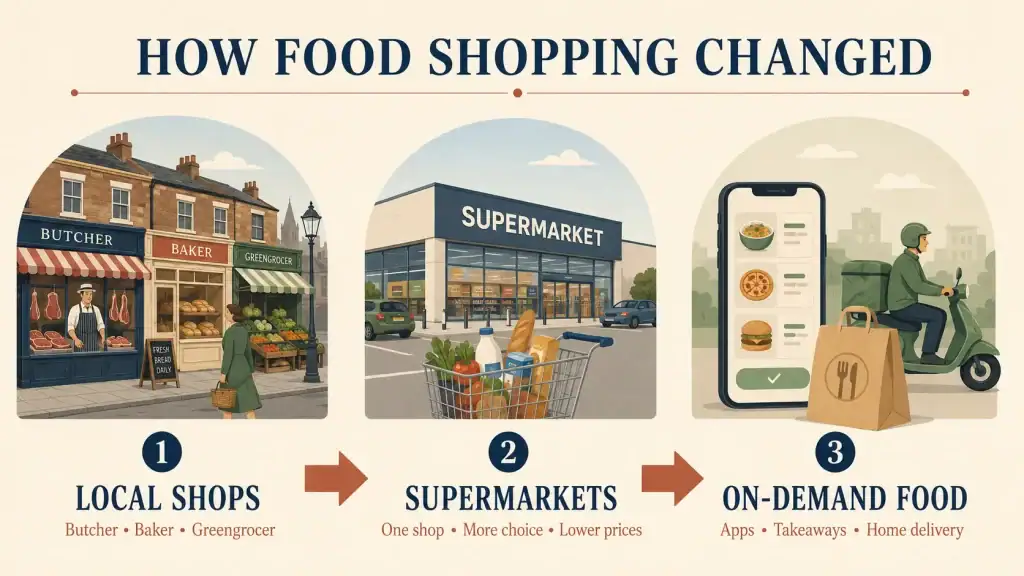
Seventy years ago, buying food in Britain often meant making several separate journeys. Meat came from the butcher, bread from the baker, fruit and vegetables from the greengrocer, and fish from the fishmonger. Milk might arrive at the door. Families used grocers, Co-operative stores, street markets and small local shops, often visiting more than once during the week.
Today, one supermarket can provide tens of thousands of products beneath a single roof. If even that feels inconvenient, a ready meal can be heated in minutes, or a restaurant meal can be ordered through an app and tracked to the front door.
This change is sometimes told as a simple morality tale: corporations destroyed traditional food, or manufacturers merely gave people the convenience they wanted. Neither explanation is sufficient.
The modern food environment developed through the interaction of technology, economics, government policy, household life, consumer demand and corporate strategy. Supermarkets did not expand in a vacuum. They grew alongside car ownership, domestic refrigerators, freezers, dual-income households, commuting and changes in town planning. Convenience foods did not become successful simply because companies advertised them. They solved genuine problems involving time, skill, cost, waste and family life. But companies also became extremely good at creating new eating occasions, engineering consistent products, positioning them prominently and turning habits into profitable markets.
This is not an argument that everything was better in 1970. Nor is it an argument that corporations are inherently malevolent. It is an attempt to explain how we arrived at the food system surrounding us today.
“The modern food environment was not designed in a single boardroom. It evolved through millions of choices—but those choices were increasingly made inside systems designed by a smaller number of powerful organisations.”
Britain Before Modern Supermarkets
The traditional British high street divided food into recognisable trades. Butchers understood cuts of meat and prepared orders at the counter. Bakers produced bread and cakes locally or regionally. Greengrocers sold loose fruit and vegetables, often with a stronger seasonal rhythm than shoppers experience today. Fishmongers handled a highly perishable product requiring specialist knowledge. Dairies organised local milk processing and doorstep delivery. Street and covered markets brought multiple traders together.
Shopping was generally more frequent. Household refrigerators were smaller, freezers were less common, and fresh food could not always be stored for long. Goods were often weighed, cut or wrapped to order. The customer saw the person selling the food, although not necessarily the farmer or producer behind it.
The system could feel more personal, but it should not be romanticised. Britain only completed post-war food rationing in 1954. Diets varied enormously by class, region, income and family background. Many households ate repetitive meals built around meat, potatoes, bread, dripping, pies, stews and puddings. Vegetables were sometimes boiled beyond recognition. Fresh produce offered less year-round variety, food safety controls were less sophisticated, and dietary options for allergies, intolerances or ethical preferences were limited.
Nor was the supply entirely local. Britain had imported tea, sugar, coffee, spices, fruit and grain for generations. National brands, canned goods, cereals, biscuits and confectionery existed long before the modern superstore.
What was different was the balance. More meals were assembled at home from basic ingredients, even when those meals were not nutritionally ideal, and snacks and sweetened drinks were less continuously available.
Self-service began changing this world before the large supermarket became dominant. A pioneering self-service supermarket was opened by the London Co-operative Society in 1948. During the 1950s and 1960s, self-service allowed people to move through aisles, inspect packaged products and make selections without requesting each item from behind a counter.
Even in 1973, however, independent stores still accounted for approximately 39% of grocery sales, although around half of that share involved shops belonging to symbol or voluntary-chain organisations rather than being entirely unaffiliated independents, according to a 1974 Parliamentary debate.
What was gained—and what was missing?
| Earlier food environment | Potential advantage | Potential disadvantage |
|---|---|---|
| Specialist local shops | Knowledge, service and visible trades | Several journeys, shorter hours and sometimes higher prices |
| More home preparation | Greater control over ingredients | Considerable unpaid domestic labour |
| Stronger seasonality | Connection to agricultural cycles | Less variety and availability |
| Smaller supply networks | Local economic circulation | Less standardisation and weaker cold-chain technology |
| Fewer convenience products | Less constant snacking | Less support for time-poor or less able cooks |
The older system also depended heavily on someone—usually a woman—having time to shop repeatedly, prepare ingredients, cook and clean. Ignoring who supplied that labour would distort the past.
“The government’s long-running Family Food datasets contain household purchasing statistics from 1974 onwards, with some predecessor data stretching back considerably further.”
The Rise of the Supermarket
The supermarket succeeded because it brought together several powerful advantages: range, price, parking, predictable opening hours and the ability to complete most food shopping in one journey.
Tesco and Sainsbury’s expanded self-service and larger-store formats. Morrisons opened its first supermarket in Bradford in 1961, having introduced a town-centre self-service shop three years earlier, according to the company’s official history. Asda grew from Yorkshire roots into a major price-led chain and was acquired by Walmart in 1999. Co-operative societies remained important, although their ownership model differed from a conventional shareholder-owned supermarket. Waitrose developed a premium position within the employee-owned John Lewis Partnership, while M&S Food became particularly influential in prepared, chilled and premium convenience food.
From the mid-1960s, large-scale food retail increasingly moved away from traditional town centres. This change accelerated through the 1980s and early 1990s as car ownership, road networks and planning decisions supported out-of-town stores. Families could drive to a superstore, fill a trolley, load the car and keep more food at home in larger refrigerators and freezers.
Takeovers accelerated the transformation. Morrisons’ purchase of Safeway in 2004 strengthened its southern presence and helped establish the “big four.” Tesco’s later purchase of Booker connected the largest grocer with a major wholesaler supplying convenience networks.
Not every proposed consolidation was permitted. In 2019 the Competition and Markets Authority blocked the proposed merger between Sainsbury’s and Asda. The CMA concluded that the deal could reduce competition and lead to higher prices or worsening quality, range and service.
Then Aldi and Lidl altered the market again.
Aldi entered Great Britain in 1990 and Lidl in 1994. Their limited-assortment model reduced complexity: fewer product lines, a high proportion of own-label goods, simpler displays and relentless attention to operational cost. The model initially appeared austere beside the vast ranges of established supermarkets, but it became increasingly attractive after the 2008 financial crisis and during later periods of food inflation.
The figures show the extent of the shift. Aldi and Lidl had a combined grocery share of under 6% in 2012. By 2023, it was approaching 18%, according to the CMA’s examination of grocery competition. Lidl now reports more than 1,000 stores and 14 regional distribution centres across Britain on its corporate website.
Just in Time
Just-in-time—or JIT—means supermarkets and manufacturers keep relatively little spare stock, relying on frequent, precisely scheduled deliveries instead. It reduces storage costs, limits waste and helps shops respond quickly to changing demand. However, efficiency can create fragility. A delayed lorry, factory shutdown, fuel shortage, cyberattack or sudden surge in demand can leave shelves empty remarkably quickly. JIT did not make food supply chains unreliable, but it reduced the spare capacity available when something unexpected happened.
Why did independent food shops decline?
Supermarket expansion was an important cause—but not the only one.
A House of Commons committee concluded that out-of-town supermarkets brought consumer benefits while also reducing town-centre vitality, contributing to corner-shop closures, encouraging car use and creating pressure for development outside existing centres. Its report on environmental effects captures the central tension: the same store could make one family’s weekly life easier while weakening the commercial ecology of the local high street.
Independent food shops struggled to match the purchasing power, opening hours, parking and one-stop convenience of large chains. Rents, business rates, succession, wholesale costs, online retail and consumer preference also mattered. Parliamentary evidence described approximately 1,000 specialist food shops closing annually during the 1990s, although this is submitted evidence rather than a perfectly harmonised official series.
Supermarkets also made many foods more affordable, brought year-round variety and supported sophisticated cold chains, traceability, allergen systems and recalls. Some small producers gained national audiences through supermarket listings.
The balanced conclusion is not that supermarkets destroyed an idyllic system. It is that consumers exchanged a dispersed network of specialist shops for a more efficient, centralised system—and that the social and economic costs of that exchange were not shared equally.
Did You Know? Aldi and Lidl are unrelated businesses. Lidl belongs to Germany’s Schwarz Group.
What happened to Britain’s butchers, bakers and greengrocers?
Britain’s independent food shops did not disappear for one simple reason, and they were not all “closed down” directly by supermarkets. Their decline resulted from several connected changes that gradually shifted the advantage towards larger retailers.
From the 1950s onwards, self-service supermarkets offered something radically convenient: meat, bread, vegetables, groceries and household products under one roof. Centralised purchasing gave the expanding chains considerable buying power, while larger premises allowed wider ranges, longer opening hours and lower prices on many everyday products.
The growth of car ownership helped supermarkets move into larger out-of-town locations with free parking. Domestic refrigerators and freezers made weekly bulk shopping practical, while changing working patterns increased the attraction of completing the family shop in one visit. Consumers were not merely passive victims of the change: millions actively chose supermarkets because they saved time and frequently saved money.
Independent shops found it difficult to match this combination. Smaller businesses generally had higher costs per item, less bargaining power with suppliers and fewer resources for advertising or modernisation. Rising rents, business rates and difficulties finding successors also contributed. Supermarket chains subsequently expanded into smaller convenience stores, placing them in more direct competition with remaining local retailers—a development noted in a UK Parliament briefing on the grocery market.
The effect was substantial. In 2019, the Agriculture and Horticulture Development Board estimated that the number of independent butchers had fallen by approximately 60% over 25 years, leaving roughly 6,000. It identified the increasing influence of supermarket chains as an important cause. Read the AHDB analysis.
Yet this should not be reduced to a story of supermarkets simply eliminating better shops. Supermarkets improved affordability, consistency and choice for many households. Conversely, the loss of specialists could also mean less personal service, less specialist knowledge, weaker local supply relationships and fewer reasons to visit traditional high streets. Competition investigations have consequently produced a more complicated picture than the claim that the major chains deliberately destroyed every smaller rival. The Competition Commission’s grocery investigation found genuine competition problems but did not conclude that supermarket growth alone explained the entire decline.
Britain’s independent food shops were not displaced by a single corporate decision. Supermarket economics, new technology, planning, car ownership, changing work patterns and consumer choices all reinforced one another.
How Convenience Food Won
Convenience food did not begin with the microwave. Canning, freezing, milling, pasteurisation and packet foods had been reducing domestic work for decades. The crucial change was the gradual construction of an entire convenience infrastructure.
Domestic freezers made it practical to store fish fingers, frozen vegetables, desserts and complete meals. Improved chilled distribution allowed retailers to sell foods with short refrigerated lives across national store networks. Modified-atmosphere packaging, preservatives and stabilisers helped products remain consistent. Microwave ovens then reduced the final stage of cooking to a few minutes.
By the 1980s and 1990s, chilled ready meals became a field of competition. M&S and the supermarkets turned cuisines that once required specialist restaurants or domestic knowledge into ordinary weekday purchases.
This expansion is sometimes presented as evidence that people became lazy. That is an inadequate explanation.
Research from the Institute for Fiscal Studies found that the share of home-cooked food in UK household spending declined from the 1980s. The authors linked part of that movement to rising labour-market participation and the increasing value of the time previously used for cooking. Their analysis of home food production makes a simple but important point: a meal’s cost is not only the price of its ingredients. It also includes planning, shopping, preparation, cooking and cleaning.
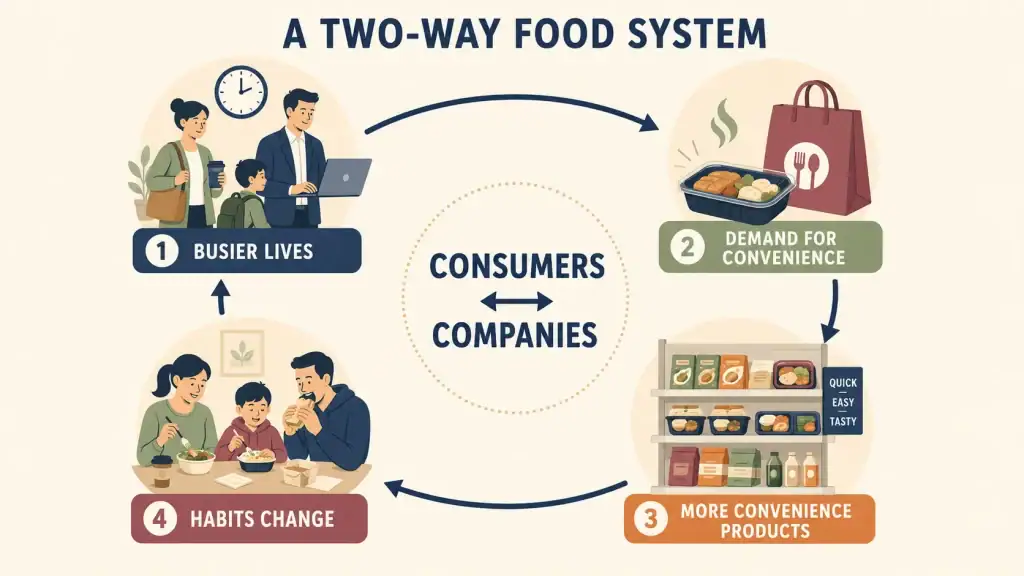
As two-income households, commuting and fragmented schedules became common, convenience products answered a real need. They also helped single people, parents seeking predictable meals and people with disabilities, limited kitchens or little cooking confidence.
Companies also created categories, advertised them and used packaging to associate convenience with modernity, pleasure or health. New products produced new habits; those habits encouraged further development.
Consumer demand and corporate strategy therefore reinforced one another.
Processed does not automatically mean unhealthy
This distinction is essential. Frozen peas are processed. So are cheese, yoghurt, canned tomatoes, wholemeal bread and pasteurised milk. Processing can preserve nutrients, destroy pathogens, reduce waste and make food affordable.
“Ultra-processed food” is a more specific category, generally referring to industrial formulations made substantially from refined or extracted ingredients and often containing additives not used in ordinary domestic cooking. It includes many sugary drinks, packaged snacks, confectionery and ready meals—but it can also include fortified cereals, flavoured yoghurt and some packaged wholegrain breads.
UK exposure is unusually high. Estimates commonly suggest that ultra-processed products provide between 51% and 68% of dietary energy, depending on age, method and socioeconomic group, according to the British Nutrition Foundation’s position statement. Research supported by the National Institute for Health and Care Research found that British adolescents obtained roughly two-thirds of their calories from ultra-processed foods during the surveyed years. NIHR’s summary also notes higher consumption among more deprived groups.
A major BMJ umbrella review found that greater exposure was associated with a range of adverse outcomes, particularly cardiometabolic disease, common mental disorders and mortality.
That evidence is serious but does not settle every question. Much is observational, and high and low consumers differ in income, lifestyle and overall diet. Researchers are still investigating the roles of nutritional profile, fibre, eating speed, food structure, additives and displacement of whole foods.
The established fact is that UK consumption is high and consistently associated with poorer health. The developing area is precisely why, and whether all foods placed within the category deserve equal concern.
“Processing is not one thing. Freezing peas, fermenting yoghurt and constructing a shelf-stable confectionery bar are all forms of processing, but they do not have the same purpose or nutritional effect.”
Fast Food Moves Into Everyday Life
American-style fast food arrived in Britain gradually and then became part of the physical landscape.
KFC opened in Preston in 1965. Pizza Hut arrived during the 1970s. McDonald’s opened its first British restaurant in Woolwich in 1974. Burger King expanded through franchise operations. Domino’s opened in Luton in 1985, and Subway entered the UK during the 1990s.
Britain also developed its own food-to-go institutions. Greggs transformed from a bakery business into a national chain selling breakfast, lunch, snacks and hot food throughout the day. Pret A Manger, founded in London in 1986, sold a more premium version of convenience, while Starbucks and Costa helped turn coffee into a portable branded purchase. Costa, founded in London in 1971, passed through Whitbread before being acquired by Coca-Cola in 2019.
These businesses expanded where and when prepared food could be bought: stations, petrol stations, retail parks, hospitals, airports and workplaces. Breakfast became a commute purchase and coffee an afternoon occasion.
Government estimates indicate that food consumed outside the home accounts for around 20–25% of adult calorie intake. When England introduced calorie labelling for large out-of-home businesses in 2022, the government noted that restaurant and takeaway portions in the underlying evidence averaged around twice the calories of comparable products bought from shops. The details are set out in the calorie-labelling announcement.
Delivery platforms created the next transformation. Just Eat brought many existing takeaway menus into one searchable system. Deliveroo added courier logistics and widened delivery to restaurants that had never operated their own drivers. Uber Eats connected food delivery to an existing technology and payment platform.
The important change was the removal of friction. Apps retained payment details, displayed photographs, ranked options, offered promotions, sent notifications and made previous orders almost instantly repeatable.
An FSA survey found that 60% of respondents had ordered food or drink from a restaurant, takeaway or café website, while 55% had used an online ordering or delivery company.
This does not mean Britons stopped eating at home. Kantar data cited by the Agriculture and Horticulture Development Board indicated that around 71% of meal occasions were still eaten at home in 2024. But “eating at home” can now mean cooking from ingredients, heating a manufactured meal, assembling snacks, using a meal kit or receiving restaurant food from a courier.
Who Actually Owns the Food Brands?
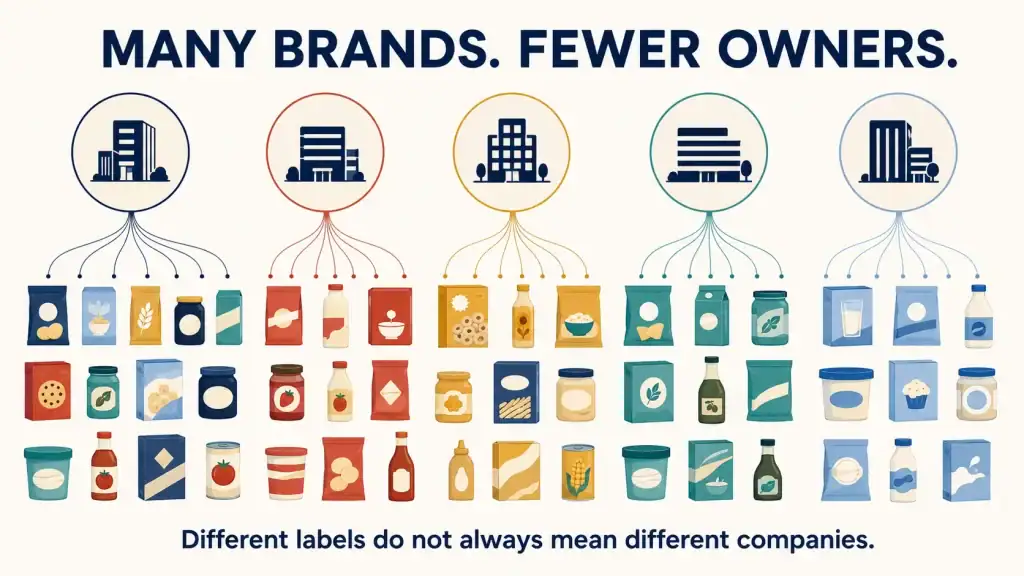
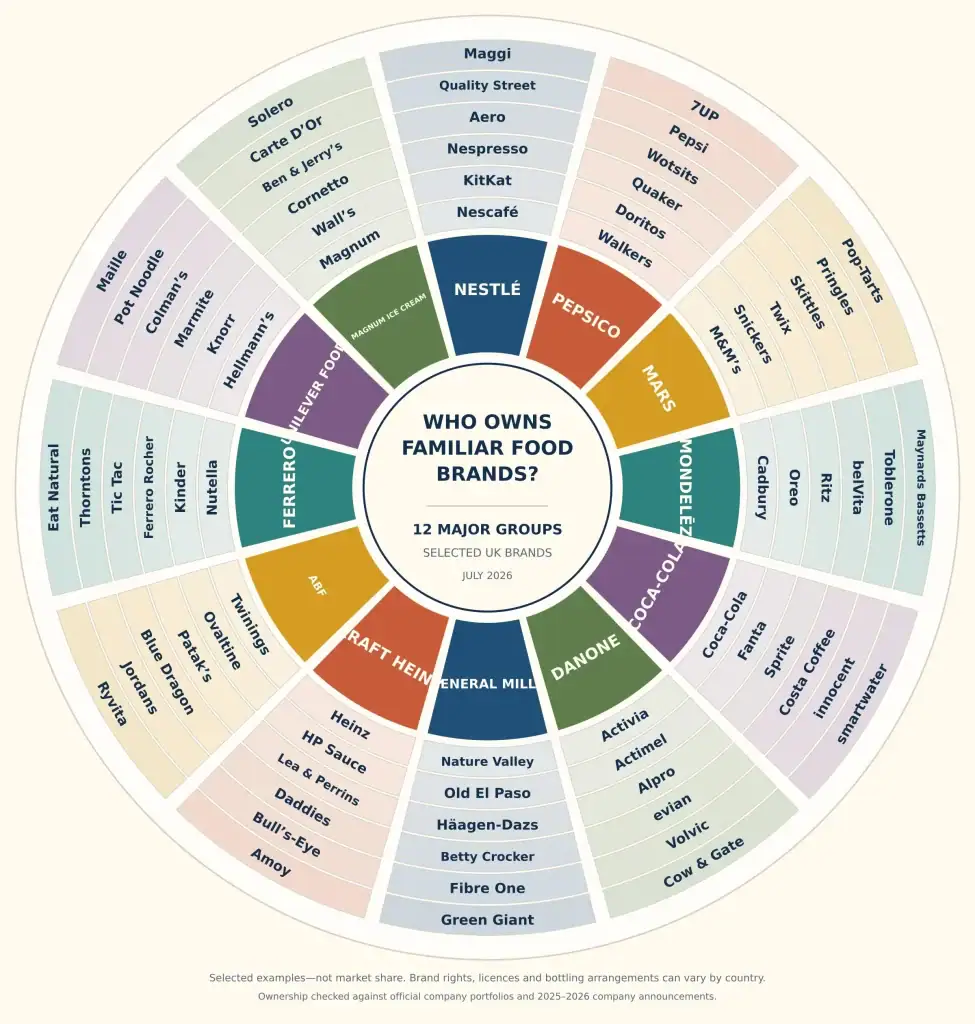
Supermarket shelves create the impression of enormous competition. Different colours, histories, mascots and price points stand side by side. Yet many apparently competing products ultimately belong to the same parent companies.
Walkers, for example, belongs to PepsiCo. The same parent owns Pepsi, Doritos, Cheetos, Quaker, Gatorade and numerous regional snack businesses. Mondelēz owns Cadbury, Oreo, Ritz, Milka, Toblerone and belVita. Nestlé’s portfolio stretches across coffee, culinary products, confectionery, nutrition, bottled water and Purina pet food.
Recent acquisitions made concentration especially visible. In December 2025, Mars added Kellanova—Pringles, Cheez-It, Pop-Tarts, RXBAR and Kellogg’s international cereals—to its existing confectionery empire, as confirmed in its official announcement.
North American Kellogg cereals followed a different path. WK Kellogg was acquired by Ferrero in September 2025, according to Ferrero’s completion statement.
Simplified ownership trees
PepsiCo
├── Pepsi and other beverages
├── Walkers / Lay's
├── Doritos / Cheetos
├── Quaker
└── Siete Foods
Mars
├── M&M's / Snickers / Twix / Galaxy
├── Skittles / Starburst / Wrigley
├── Pringles / Cheez-It / Pop-Tarts
├── Kellogg's international cereals
├── Ben's Original / Dolmio
└── Pedigree / Whiskas / Royal CaninMondelēz
├── Cadbury / Milka / Toblerone
├── Oreo / Ritz / LU / belVita
├── Clif / Grenade
└── Sour Patch Kids / HallsNestlé sells specified Starbucks packaged products under licence; it does not own Starbucks. Hershey makes KitKat under licence in the United States, while Nestlé controls it in most other markets. Philadelphia cream cheese rights differ by territory. Häagen-Dazs has a complicated geography of ownership and operation. Some businesses are joint ventures, others controlled public subsidiaries, and many soft drinks are manufactured by independent bottlers.
Coca-Cola is a useful example. The Coca-Cola Company generally owns brands and produces concentrates and syrups, but much of the finished product is manufactured and distributed by bottling groups such as Coca-Cola Europacific Partners, Coca-Cola HBC and Coca-Cola FEMSA. Coca-Cola describes this structure through its official explanation of the Coca-Cola system. These bottlers should not simply be drawn as ordinary wholly owned subsidiaries.
Ownership also moves apart. Unilever sold its spreads business to what became Upfield and separated its tea operation. Its December 2025 ice-cream demerger means Magnum, Wall’s, Cornetto and Ben & Jerry’s no longer sit inside Unilever.
The accurate conclusion is not that ten corporations own all food. Globally, several dozen major consumer manufacturers operate alongside regional giants, dairy co-operatives, meat processors, private-label specialists, bottlers and upstream commodity businesses.
Upstream groups such as ADM, Cargill, Bunge, Olam and Wilmar may supply oils, grains, cocoa, starches, proteins, sweeteners or flavours used under somebody else’s brand. Concentration therefore exists at several levels.
Did You Know? Associated British Foods owns Kingsmill, Twinings, Ovaltine, Ryvita, Jordans, Patak’s, Blue Dragon and Silver Spoon—and also owns Primark.
Who Owns the Owners?
The ownership wheel shows which corporations control familiar brands, but there is another layer above many publicly traded food companies: the investment institutions that hold their shares.
The modern global food system did not emerge through a single coordinated plan. It developed through decades of acquisitions, mergers, licensing agreements, joint ventures and international expansion. Nestlé acquired Rowntree in 1988, bringing KitKat, Aero and Quality Street into its portfolio. Kraft purchased Cadbury in 2010 before separating much of its international snack business into Mondelēz. Kraft subsequently merged with Heinz, while Mars completed its $35.9 billion acquisition of Kellanova in 2025, adding Pringles, Pop-Tarts and international Kellogg’s cereals to its existing confectionery empire. Nestlé · Mars
Companies also cooperate without buying one another. They establish joint ventures, share suppliers, licence trademarks and use independent manufacturers, distributors and bottlers. Nestlé and General Mills, for example, created Cereal Partners Worldwide to sell breakfast cereals internationally. The Coca-Cola Company owns valuable drink brands and concentrates, but much of the physical production and distribution is undertaken by regional bottling partners. This makes the food system more interconnected than an ownership diagram alone can show.
Where BlackRock and Vanguard Fit In
BlackRock, Vanguard and State Street frequently appear among the largest shareholders in publicly traded food companies. This has produced claims that these investment firms secretly “own” or control most of the food industry. The reality is more complicated.
They are primarily asset managers. Their mutual funds, pension mandates and exchange-traded funds hold shares on behalf of millions of individual savers, pension schemes and institutional clients. If somebody’s pension invests in a fund tracking the S&P 500, that fund will automatically hold shares in companies including Coca-Cola, PepsiCo, Mondelēz and General Mills. The asset manager’s name consequently appears on regulatory ownership filings, although the underlying economic interests belong largely to its investors.
Nevertheless, this does not make the asset managers powerless. Shares normally carry voting rights, and investment managers may vote on matters including directors, executive pay, auditing and shareholder proposals. BlackRock says that it engages with companies and votes at shareholder meetings as a steward of client assets. Vanguard and State Street operate comparable stewardship programmes, although all three are gradually allowing more investors to select how their proportionate shares are voted. BlackRock · Vanguard · State Street
The scale is substantial. General Mills’ 2025 proxy statement recorded Vanguard with 12.5% of its shares, BlackRock with 10.4% and State Street with 5.9%. Coca-Cola’s 2026 proxy listed Berkshire Hathaway at 9.29%, Vanguard at 8.61% and BlackRock at 7.28%. These holdings do not make any one institution the controlling owner, but together they represent a significant voting presence. General Mills SEC filing · Coca-Cola 2026 proxy
Other influential investors include pension funds, insurance companies, sovereign-wealth funds, Capital Group, Fidelity, Geode Capital and Norges Bank Investment Management. Berkshire Hathaway is different again: it is an investment holding company that takes large, long-term positions using its own capital and that of its subsidiaries. It has been Coca-Cola’s largest shareholder for decades and was instrumental in the formation of Kraft Heinz.
Does Common Ownership Reduce Competition?
When the same investment managers hold shares in competing manufacturers, economists call it common ownership. Critics argue that investors with interests across an entire industry may prefer stable profits across all companies rather than aggressive competition by one company against another. They also question whether so much shareholder voting power should be administered by a small number of investment organisations.
However, this does not prove that BlackRock or Vanguard instruct food manufacturers to coordinate prices, recipes or business decisions. The companies retain separate boards, executives and commercial strategies, and direct collusion remains illegal. Research into whether common ownership materially weakens competition has produced disputed results, while the asset managers maintain that they do not seek operational control and act solely for their clients’ financial interests.
The balanced conclusion is therefore neither that investment managers are irrelevant nor that they secretly command the food industry. They form an influential financial layer above many corporations, particularly through voting and engagement, but that influence is indirect, divided among numerous funds and constrained by company law, competition law and fiduciary duties.
Modern food ownership is best understood as several overlapping layers:
Consumers and pension investors → investment funds → corporate shareholders → parent companies → subsidiaries and brands → manufacturers, bottlers and retailers.
That structure can concentrate economic influence without requiring a hidden central controller. It is a consequence of global capital markets, passive investing, corporate consolidation and the continuing search for scale—not evidence that every food company is being directed from one boardroom.
What Happens When Food Is Reformulated?
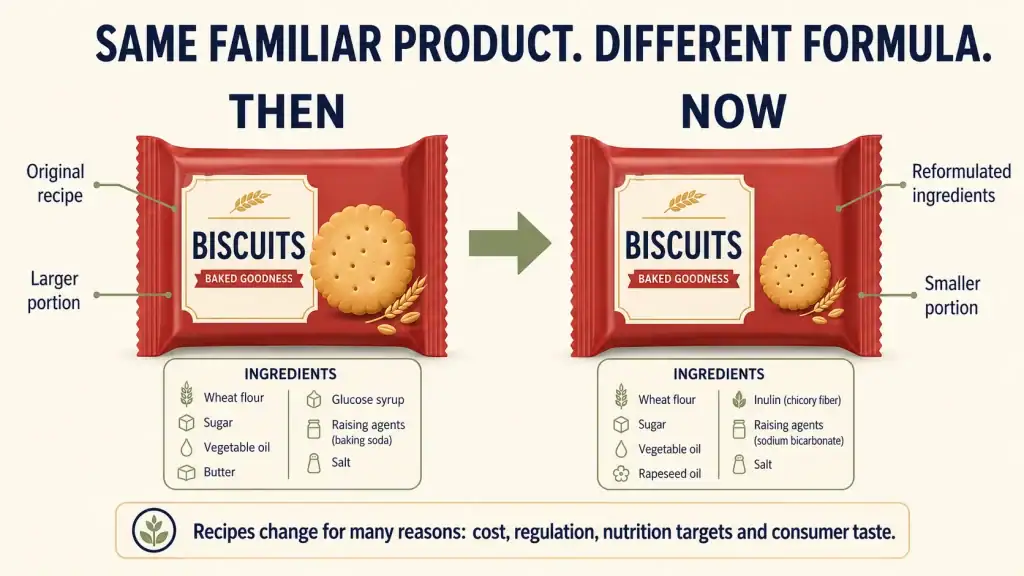
People often notice that a favourite product tastes different and assume the company has replaced expensive ingredients with cheaper ones. Sometimes that is correct. Sometimes a recipe changed for health reasons, supply problems or legal compliance. Sometimes the recipe did not change in the way consumers believe.
Manufacturers reformulate for many reasons:
- sugar or salt targets;
- taxes;
- ingredient prices;
- shortages and supply security;
- shelf life;
- allergen requirements;
- consumer testing;
- manufacturing efficiency;
- changes in law;
- demand for vegan or “clean label” products;
- cost reduction.
An acquisition can create pressure to standardise operations or improve margins, but it is only one cause among many.
Sugar: unusually strong evidence
The UK’s Soft Drinks Industry Levy provides one of the clearest examples of policy changing corporate behaviour. The levy was announced in 2016 and introduced in 2018 with charges linked to sugar concentration.
Rather than simply passing the cost to consumers, many companies changed their recipes to fall below the levy thresholds. The government’s review of the levy reports an average 46% reduction in sugar in drinks covered by it between 2015 and 2020.
This is established evidence of reformulation. Some products used non-sugar sweeteners or altered flavour systems. The World Health Organization recommends against relying on non-sugar sweeteners for long-term weight control, but its guidance is not equivalent to declaring every authorised sweetener poisonous at permitted exposure.
There is substantial evidence that sugar interests promoted consumption through advertising, recipe campaigns, nutritional messaging and political activity. Sugar was marketed as a source of quick energy, and industry-funded organisations sought to present it favourably.
A detailed US Department of Agriculture history of sugar marketing records extensive government and industry efforts to expand production, protect markets and promote consumption, but does not document a strategy of free household bags designed to establish addiction. Tate & Lyle also conducted major public campaigns, including its documented 1949 “Mr Cube” campaign, although that campaign principally opposed nationalisation rather than introducing consumers to sugar. Tate & Lyle’s company history confirms the campaign’s historical context.

Salt
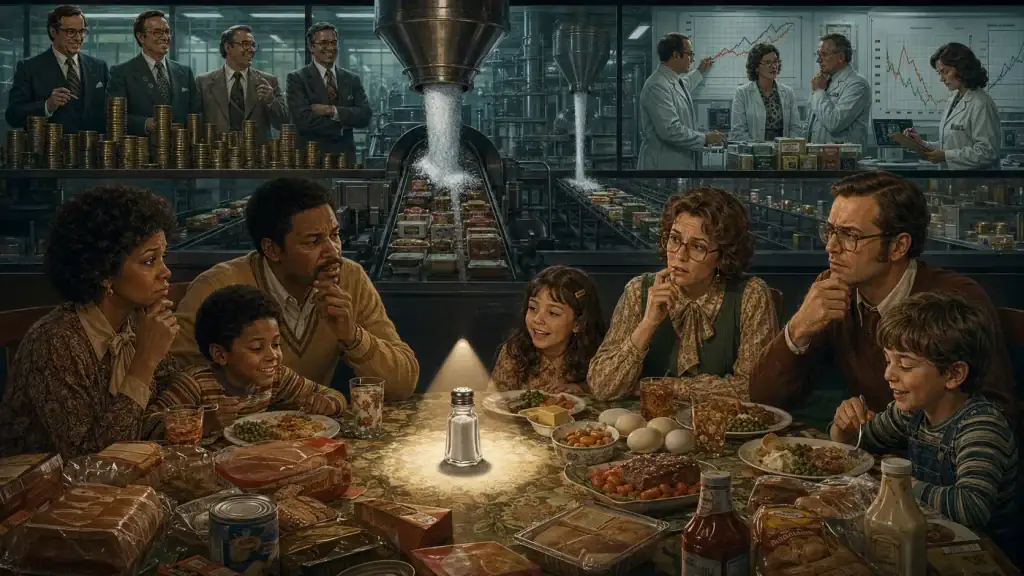
Britain has pursued gradual salt reduction since the early 2000s. Salt is not included merely for taste: it can affect preservation, texture and manufacturing performance. Gradual reductions are often less noticeable because preference can adapt, but progress has been uneven across product categories.
Salt has often been presented as something inherently harmful, but sodium and chloride are essential nutrients. They help regulate fluid balance and blood pressure, transmit nerve signals, support muscle contraction and maintain normal circulation. Too little sodium can be dangerous, particularly during prolonged exercise, heavy sweating, illness or excessive water consumption, which can dilute the blood’s sodium level—a condition called hyponatraemia.
The misleading part of earlier public messaging was not the claim that excessive salt can raise blood pressure; that is well established, especially in salt-sensitive people. It was the suggestion that salt is universally harmful and that everyone benefits equally from consuming as little as possible. Some research indicates that extremely low sodium intake may activate stress hormones and may not suit everyone.
As with water, the dose and circumstances matter. Most unnecessary salt now comes from manufactured foods, not modest seasoning added to nutritious home cooking. NHS guidance recommends no more than 6g of salt daily for most adults, while ongoing research contin
Fats and “seed oils”
Traditional fats such as butter, lard and beef dripping were increasingly replaced in manufactured foods by inexpensive, highly refined oils including rapeseed, sunflower, soybean and corn oil. Whether this improved health remains disputed.
Removing industrial trans fats was beneficial, but some historical trials failed to show the expected mortality benefit when animal fats were replaced with linoleic-acid-rich vegetable oils. Repeated high-temperature frying also oxidises and degrades oils, producing potentially harmful compounds.
This does not prove that every seed oil is toxic. Nevertheless, concerns about intensive processing, repeated heating and their enormous presence in ultra-processed foods deserve serious attention. A precautionary approach is reasonable: eat fewer fried and manufactured foods, never repeatedly reheat oil, and favour traditional, minimally processed fats—particularly extra-virgin olive oil.
Emulsifiers, preservatives and flavourings
Emulsifiers keep ingredients mixed and create consistent texture. Preservatives can prevent mould and dangerous microbial growth. Colours and flavourings maintain a predictable sensory experience across factories, seasons and ingredient batches.
UK rules permit additives only in specified foods and within defined conditions, listed by the Food Standards Agency.
Emerging observational research has linked some emulsifiers with diabetes or cancer risk, while laboratory work suggests possible gut effects. The evidence is developing: emulsifiers differ, exposure is difficult to measure, and studies cannot fully exclude other factors.
The responsible conclusion is neither “all additives are harmless” nor “all additives are dangerous.” It is that authorised additives have assessed technological uses, while the long-term effects of certain patterns and combinations remain active research questions.
Fortification
Industrial food can also add nutrients. Flour, cereals, spreads and other staples may be fortified with iron, folic acid, vitamin D or B vitamins. Fortification has prevented deficiencies and can be especially valuable at population level.
It can also create a health halo. Adding vitamins to a sugary cereal does not reproduce the structure and full nutritional profile of an intact food. Both statements can be true.
Shrinkflation: Paying the Same for Less
Shrinkflation describes a disguised price increase: a product becomes smaller while its shelf price remains unchanged—or sometimes rises. The modern term is often attributed to economist Pippa Malmgren, but the practice is much older. Manufacturers have reduced pack sizes during periods of rising costs for decades, including the inflationary 1970s.
Companies use shrinkflation because shoppers usually notice a visible price increase more readily than a small reduction in weight. A chocolate bar can fall from 200g to 180g, for example, while retaining familiar packaging and approximately the same price. The unit price has increased, even if the figure displayed on the shelf has not.
The practice became especially noticeable in Britain during the 2010s. The Office for National Statistics identified 206 products that shrank between September 2015 and June 2017, with food forming the largest group. Toblerone’s conspicuously widened gaps became a famous example in 2016.
Shrinkflation accelerated again as manufacturers faced rising energy, ingredient, transport and labour costs after the pandemic and the invasion of Ukraine. Reducing portions is not automatically dishonest—the weight must appear on the package—but it can exploit habitual buying and make price increases harder to recognise. Comparing prices per 100g, rather than per packet, reveals what has really changed.
A documented acquisition-era change—and an uncertain one
After Kraft acquired Cadbury in 2010, the shell of the UK Cadbury Creme Egg changed in 2015 from Dairy Milk to what the company described as a standard cocoa-mix chocolate. The multipack also moved from six eggs to five. This is a documented post-acquisition product and pack change.
Claims about the core UK Dairy Milk recipe are less secure. Many consumers insist that it tastes different, while Cadbury has said its central ingredient recipe remained unchanged for decades. Perceived flavour can also be affected by sourcing, processing, shape, storage and expectation. Without reliable archived ingredient panels and manufacturing information, it would be wrong to present the stronger allegation as established fact.
This distinction matters. A credible examination of food reformulation should be willing to say “we do not yet know.”
How Corn Syrup Replaced Sugar in America
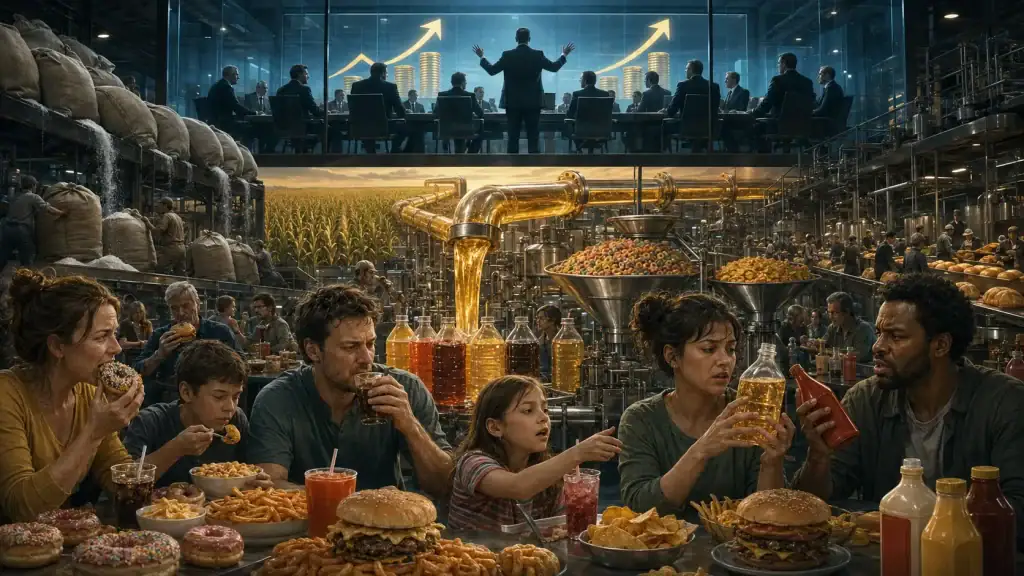
High-fructose corn syrup began entering American processed foods during the 1970s. It was inexpensive, consistently sweet, easy to transport as a liquid and particularly useful in soft drinks, sauces, baked products and packaged foods. American agricultural and trade policies also made domestically produced corn comparatively attractive while imported sugar remained expensive.
By the 1980s, major American soft-drink manufacturers had largely replaced cane or beet sugar with high-fructose corn syrup. American supplies peaked in 1999 at approximately 65.9 pounds per person annually, but consumption has since declined substantially. By 2011, ordinary refined sugar had once again overtaken corn sweeteners.
This was mainly an American transformation. British and European manufacturers continued to rely much more heavily on ordinary sugar, although glucose-fructose syrup—sometimes labelled isoglucose—is used in some European products.
High-fructose corn syrup is often portrayed as uniquely dangerous. However, it contains broadly similar proportions of glucose and fructose to ordinary table sugar. The strongest established concern is therefore the quantity of added sugar consumed, rather than convincing evidence that corn syrup is uniquely toxic. Replacing it with cane sugar does not automatically make a heavily sweetened product healthy.
Further reading: US Department of Agriculture sweetener data, USDA historical comparison of sugar and corn sweeteners and the FDA explanation of high-fructose corn syrup.
Did You Know? High-fructose corn syrup did not take over globally. Its dominance was principally an American phenomenon, strongly influenced by the economics of the American corn and sugar markets.

Do Artificial Sweeteners Keep Us Craving Sugar?
Artificial sweeteners were introduced as a way of delivering sweetness without sugar’s calories. Yet researchers are investigating whether this apparent advantage carries an unintended cost. Sweet taste normally tells the brain that energy is arriving. When the expected calories and hormonal signals fail to appear, appetite may not be satisfied in quite the same way.
A 2025 randomised study found that sucralose produced greater hunger and more activity in the brain’s appetite-regulating hypothalamus than a sweetness-matched sugar drink. Sucralose also failed to trigger the glucose, insulin and GLP-1 responses produced by sugar. The findings support the possibility that sweetness without energy can alter appetite signalling, particularly in people with obesity.
That does not prove that artificial sweeteners inevitably cause sugar cravings. Longer studies generally find no consistent increase in sweet-food preference or calorie consumption, and different sweeteners may produce different effects. Nevertheless, emerging research concerning sucralose, individual metabolic responses and the gut microbiome means these substances should not simply be regarded as metabolically invisible.
Used temporarily to replace large quantities of sugar, sweeteners may reduce calorie intake and tooth decay. Used indefinitely while preserving an intensely sweet diet, their long-term value is less certain. The most defensible approach is therefore not merely replacing all sugar with artificial sweetness, but gradually becoming less dependent on heavily sweetened food and drink altogether.
How Cereal Manufacturers Sold Us Breakfast
We have been told for generations that “breakfast is the most important meal of the day,” but that is not an established nutritional fact. People have different appetites, routines and metabolic needs, and no particular meal is automatically more important than every other. What is true is that cereal manufacturers repeatedly promoted this message because it gave people a reason to consume their products every morning.
Packaged cereal did not simply become popular because families independently discovered its nutritional value. Companies created demand through enormous advertising campaigns, health claims, free samples and the promise of convenience. They presented processed cereal as modern, scientifically designed and essential for healthy, successful families.
They then turned their attention to children. Cartoon mascots, brightly coloured packets, television advertising, competitions, toys and free gifts transformed breakfast into entertainment. Children nagged their parents for the cereal connected to their favourite character—while manufacturers made the products increasingly sweet, colourful and difficult to resist.
Let’s be honest: many mainstream cereals are poor-quality food. They are frequently made from refined grains, sugar, salt and flavourings before being fortified with vitamins and promoted as nutritious. Adding iron or vitamin D does not magically cancel out the sugar or turn a highly processed product into a balanced meal. The fortification and wholegrain claims can create a convenient health halo around what is sometimes closer to confectionery than traditional food.
Not every cereal is rubbish. Plain porridge, shredded wheat and genuinely low-sugar wholegrain cereals can provide useful fibre and nutrients. But much of the cereal aisle exists because manufacturers successfully persuaded us that everybody needs breakfast, that breakfast means cereal and that a cartoon-covered box of sweetened grain is somehow an appropriate daily meal for a child.
Call that clever marketing if you like. Those of us wearing slightly shinier hats might call it the deliberate manufacture of a lifelong habit.
Government Did Not Simply Stand Aside
Government has influenced the food environment throughout the period: first through rationing and post-war nutrition policy, then through safety standards, dietary advice, school meals, labelling, taxation and advertising rules.
School meals were originally connected to welfare and child nutrition. Provision changed after the 1980 Education Act, and concern about quality returned forcefully during the 2000s. Modern school food standards attempt to control nutritional content, but budgets, staffing, kitchen facilities and monitoring remain practical limitations.
The Food Safety Act 1990 and the establishment of the Food Standards Agency in 2000 strengthened the modern safety system. Industrial scale can magnify the consequences of failure, because one contaminated production line may distribute nationally. The same scale also supports hazard analysis, traceability, allergen procedures, cold-chain monitoring and rapid product recalls.
Front-of-pack traffic-light labelling was developed to make levels of fat, saturated fat, sugar and salt easier to compare. Its advantage is speed. Its limitation is reduction: a coloured panel cannot describe everything about processing, food structure, additives or an overall diet.
Recent policy has moved beyond providing information and begun altering the environment in which choices occur.
England introduced restrictions on placing less-healthy products at checkouts, entrances and aisle ends in 2022. Volume-price promotion restrictions followed. UK-wide rules restricting paid online advertising and television advertising of specified less-healthy foods before the 9pm watershed legally commenced in January 2026. The government maintains a collection of the current advertising and promotion rules.
These policies recognise an important reality: where a product appears, how often it is seen and how its price is framed can influence purchasing.
Critics raise legitimate questions. Nutrient-profile rules do not match the definition of ultra-processed food. Some nutritious products may fall within broad categories, while some highly processed low-sugar products fall outside them. Advertising restrictions may affect smaller businesses differently from multinational firms. Calorie labels can help some consumers while being ineffective or distressing for others.
Policy is therefore not a clean struggle between government and industry. It is an ongoing attempt to define which harms matter, how they should be measured and who should bear the cost of changing them.
Eggs and the Changing Nutrition Consensus
or decades, eggs were treated with suspicion because egg yolks contain dietary cholesterol. The apparently straightforward assumption was that eating cholesterol would substantially raise blood cholesterol and therefore increase the risk of heart disease.
Later evidence showed that the relationship is considerably more complicated. For most people, dietary cholesterol has a relatively modest effect on blood cholesterol compared with factors such as genetics and the overall amount of saturated fat in the diet. Eggs are also a useful source of protein, vitamin B12, choline and several other nutrients.
This does not mean that unlimited egg consumption is necessarily appropriate for everyone. Individual responses differ, and people with familial hypercholesterolaemia, diabetes or established cardiovascular disease may need personalised advice. Preparation and context matter too: a boiled egg served with vegetables is nutritionally different from eggs regularly accompanied by processed meat, fried bread and large quantities of butter.
It is fair to say that eggs were frequently presented as more dangerous than the evidence now supports. However, “we were lied to” implies deliberate deception. The more accurate conclusion is that early nutritional advice simplified an uncertain relationship, while later research produced a more complete picture.
HEART UK advises that eggs are suitable for most people, while the British Heart Foundation notes that moderate consumption—up to approximately one egg daily—can form part of a healthy diet.
Did You Know? The cholesterol contained in food is not the same thing as the cholesterol circulating in your blood—and, for most people, eating an egg has considerably less effect on blood cholesterol than was once assumed.
Consumers and Corporations Changed Together
It is tempting to assign blame either to corporations or to consumers. That creates a false choice.
People buy convenient food because they are busy, price-sensitive, caring for children, working shifts or living alone. They also buy it because it tastes good, is promoted and has become normal. A rational decision on one difficult evening can still become a poor weekly pattern.
Corporations respond to demand but also shape it through packaging, advertising, checkout placement, portion sizes, limited editions and app notifications.
Price shapes nearly every part of this process. During recent food inflation, the CMA observed consumers moving toward discounters, own labels, cheaper products and less expensive proteins. A household under financial pressure cannot respond to health advice as if price and storage were irrelevant.
Loyalty schemes illustrate the complexity. Critics suspected supermarkets were inflating ordinary prices to create artificial member discounts. The CMA examined around 50,000 loyalty-priced products and found very little evidence of that practice. Its findings indicated average savings of roughly 17–25% against usual prices at the supermarkets examined.
Those savings can be genuine while schemes still collect valuable data and disadvantage non-members.
Food choice is best understood as an interaction:
Income, time, skills and family needs
                  ↕
Price, availability, placement and marketing
                  ↕
Habits, preferences, technology and policy
                  =
               Food choice
People make choices, but they do not choose the prices, shop layouts, delivery algorithms or working hours surrounding those choices. Companies shape the environment, but they cannot indefinitely sell products nobody wants.
Terence McKenna: sugar, television and accepted addictions
The book you were remembering is almost certainly Terence McKenna’s Food of the Gods, first published in 1992. It examines humanity’s relationship with consciousness-altering substances and extends the idea of a “drug” beyond illegal substances to include socially accepted commodities and technologies.
McKenna discussed sugar as a powerful, culturally normalised stimulant and treated television as a kind of electronic drug capable of absorbing attention and delivering highly repeatable messages. His description of television as the “dominator drug par excellence” appears in the book, whose published summary explicitly covers the history of sugar and ends with television. See the book record and summary.
It would be safest not to write that McKenna definitively named sugar and television as “the two biggest addictions.” I could not verify that exact formulation in a primary source. It appears to be a popular condensation of two related arguments he made.
His discussion is best presented as cultural criticism rather than established medical science. Modern evidence supports concerns about excessive free-sugar consumption, while problematic television or screen use can become habitual and harmful. However, neither point automatically validates all of McKenna’s broader theories about drugs, human evolution or social control.


What Comes Next?
The next food transformation may be less visible than the rise of the supermarket.
Artificial intelligence already supports inspection, forecasting, recipe development and consumer analysis. It could reduce waste and improve nutrition—or optimise texture, purchasing triggers and personalised advertising.
Precision fermentation uses microorganisms such as yeast or bacteria to produce specific proteins, fats, enzymes or flavours. It may allow dairy-identical proteins to be made without a cow and create ingredients with tightly controlled properties. The Food Standards Agency identifies precision fermentation as one of the technologies likely to become increasingly relevant to the UK food supply and is researching consumer responses and regulatory questions.
Cultivated food grows animal cells in controlled systems rather than raising the entire animal. Its advocates point to reduced slaughter, land use and supply vulnerability. The uncertainties include cost, energy requirements, production at scale, consumer acceptance and nutritional equivalence.
Personalised nutrition may combine medical history, activity, glucose response and microbiome data. Its promise is precision; its risks include weak tests, privacy loss, unequal access and commercial steering.
Automation will continue through robotic packing, machine vision, warehouses, kitchens and delivery. It may reduce cost and waste, but capital-intensive systems can strengthen the advantages of the largest firms.
Further consolidation is likely, but it will not move in only one direction. Large companies acquire promising challenger brands and technologies, yet they also sell divisions and divide unwieldy groups. Mars buying Kellanova, Ferrero buying WK Kellogg and Unilever separating its ice-cream business all occurred within the same broad period.
The Food Standards Agency’s 2025–2035 watchlist includes fermentation, cellular agriculture, molecular farming, edible insects, controlled-environment agriculture and 3D food printing.
These technologies are neither inherently liberating nor inherently dystopian. Their effects will depend on who controls them, how they are regulated, what they replace and whether the claimed benefits survive real-world evidence.
“The future food system may be shaped as much by microbes, cell cultures, algorithms and patents as by farms and kitchens.”
So, Did Food Become Worse?
Food became safer in many respects, more varied and easier to store. Refrigeration, pasteurisation, fortification and logistics brought real benefits. Supermarkets lowered prices, while convenience products reduced domestic labour.
But the British diet now contains a very high proportion of ultra-processed products. Snacks, sweetened drinks and prepared food are almost everywhere. Eating occasions expanded, specialist retailers declined, ownership concentrated and purchasing became increasingly frictionless.
Other questions remain unsettled.
We do not yet know how much of the health association surrounding ultra-processed food results from processing itself rather than nutritional profile, eating speed, food structure, additives or displacement of better food. The evidence around particular emulsifiers is developing rather than complete. Many widely repeated stories about recipes being cheapened after takeovers have not been properly documented. New technologies may improve resilience and nutrition—or concentrate control further.
The modern food environment did not arise from one conspiracy, one government or one generation losing the ability to cook. It evolved because supermarkets were efficient, convenience was valuable, technology made new products possible, corporations pursued growth, governments alternately encouraged and restrained markets, and consumers repeatedly chose options that solved immediate problems.
That does not make the outcome inevitable or beyond change.
Once we understand that food choice is shaped by an environment, we can ask better questions. Which forms of processing provide genuine value? Which products exploit convenience while offering poor nutrition? When does corporate scale improve safety and affordability, and when does it weaken competition? Which policies change behaviour without creating new problems? What information would allow consumers to make meaningful comparisons?
The food system surrounding us was built over decades. Understanding how it was built is the first step towards deciding what should come next.
“Eat ze Bugz”: Choice, Influence and the World Economic Forum
The phrase “eat ze bugz” or “eat the bugs” did not come entirely from somebody’s imagination. The World Economic Forum has repeatedly published articles promoting insects as a sustainable source of protein. Titles have included “Good grub: why we might be eating insects soon” and “5 reasons why eating insects could reduce climate change”. These articles presented mealworms, crickets and insect powder as possible alternatives to conventional meat.
The WEF cannot force anyone to eat insects. It is not a world government and does not pass national laws. Nevertheless, it brings politicians, multinational corporations, investors and influential academics together, so it would be naïve to pretend that its ideas carry no weight. Diets can be reshaped without compulsion through investment, environmental targets, farming policy, product development, advertising and the gradual normalisation of unfamiliar ingredients.
Historian Yuval Noah Harari—pronounced approximately “Yoo-val Noah Ha-RAH-ree”—is frequently associated with Klaus Schwab and the WEF because he has spoken at its Davos meetings about technology, artificial intelligence and humanity’s future. However, I found no evidence that Harari devised its insect-food proposals or worked directly under Schwab. His inclusion in this discussion is more about the disturbing technocratic worldview surrounding Davos than evidence that he personally instructed people to eat insects.
Some commentators have also argued that Western opposition to insect eating reflects prejudice against cultures in which insects are traditionally consumed. There is a legitimate historical point here: colonisers sometimes described other cultures and their food as primitive or uncivilised. But accusing an individual of racism simply because they do not want cricket powder in their dinner is manipulative nonsense. A widely circulated screenshot apparently showing the WEF making that accusation was fabricated, although similar arguments have certainly been made by other writers and social-media users.
The real concern does not require an imaginary secret order. Powerful organisations are openly discussing how ordinary people should travel, consume energy and eat, while the wealthy people attending elite conferences are unlikely to surrender their own choices. Consumers should be free to eat insects if they wish—but equally free to reject them, demand unmistakable labelling and question who profits when traditional farming is restricted while corporate-controlled “alternative proteins” receive investment and political support.


Lab-Grown and 3D-Printed Meat: Is This Really the Future We Want?
Lab-grown and 3D-printed meat sounds like something from dystopian fiction, but corporations and investors are already spending substantial sums attempting to make it commercially viable. It is not currently being produced in ordinary homes, nor is it secretly filling British supermarket shelves. Nevertheless, some technology companies clearly envisage a future in which manufactured proteins become a normal part of everyday life.
Several different technologies are involved. Companies such as Redefine Meat use industrial 3D printers to arrange plant proteins, oils, starches and flavourings into layers resembling muscle and fat. Cultivated meat goes further: animal cells are placed inside nutrient-rich liquid and multiplied in industrial bioreactors. Biological printing can then arrange cultivated muscle and fat cells into something approximating a steak.
The machine does not create food from nothing. Cultivated meat contains protein because it is made from animal cells, while printed plant alternatives generally use concentrated soy, wheat or pea protein. However, it cannot simply be assumed that either product possesses the complete nutritional profile of traditionally raised meat. Vitamin B12, haem iron, zinc, fatty acids, texture and flavour may need to be deliberately controlled, added or manufactured. Long-term studies of people regularly eating cultivated meat do not yet exist.
The companies pursuing this include UPSIDE Foods, GOOD Meat, Aleph Farms, Redefine Meat, Cocuus and Steakholder Foods. UPSIDE Foods’ $400 million investment round included conventional food corporations Cargill, Tyson Foods and flavouring manufacturer Givaudan. It also included Singapore’s state-owned investment company Temasek, the Abu Dhabi Growth Fund and individual investors including Bill Gates. The investor list was published by UPSIDE Foods itself.
This does not prove that Gates or these corporations are secretly planning to abolish conventional meat. It does demonstrate that extremely powerful investors want a commercial position if food production moves from farms into patented industrial systems.
Supporters say cultivated meat could reduce slaughter, land use, methane and certain forms of contamination. Those are reasonable possibilities. However, maintaining sterile bioreactors requires energy, temperature control, oxygenation, purification and expensive growth media. Its environmental advantage therefore depends heavily on production methods and access to renewable energy; it cannot yet be presented as automatically greener than farming.
Following the COVID pandemic, people are understandably more sensitive to technologies involving laboratories, biological materials and powerful institutions. Cultivated meat is unrelated to the origin of COVID, but public trust cannot be demanded. It must be earned through independent testing, transparency and unmistakable labelling.
Home printers may eventually shape factory-produced cartridges, but families will not be growing steaks safely from cells in their kitchens anytime soon. The deeper concern is the future being proposed: food based upon proprietary cell lines, manufactured ingredients, software-controlled machinery and corporate intellectual property. People should remain free to try it—but equally free to reject it and continue choosing recognisable food produced by farmers rather than technology companies.
Frequently, Infrequently and Frankly Unnecessarily Asked Questions
Do supermarkets really make food cheaper?
Often, yes. Their enormous buying power, efficient distribution and competition can reduce prices. However, savings vary by product, while loyalty pricing and fewer local competitors can complicate comparisons. The Competition and Markets Authority found that supermarket competition generally helps restrain prices—but “cheapest” does not necessarily mean best quality or greatest long-term choice.
Why do so many food brands belong to the same companies?
Because established brands provide instant customers, shelf space and recognition. Large corporations acquire them to enter new markets, reduce competition and share manufacturing, advertising and distribution costs. The supermarket may appear to offer dozens of competing choices, although several supposedly rival products can ultimately send their profits to the same parent company.
Did people really shop at butchers every day?
Some did—but not everyone visited the butcher daily. Before widespread refrigerators, freezers and car ownership, households bought perishables more frequently and visited separate butchers, bakers and greengrocers. Research into British shopping during the 1950s describes weekly and sometimes daily shopping, shaped by storage, budgets and local routines.
Does processed always mean unhealthy?
No. Freezing vegetables, pasteurising milk, canning beans and baking bread are all forms of processing. The more useful questions concern what processing adds or removes. Foods containing excessive salt, sugar or refined starch deserve scrutiny, but condemning everything “processed” would place frozen peas and fizzy drinks in one rather unhelpful category.
Did sugar help drive the transatlantic slave economy?
Yes—very substantially. European demand for sugar made Caribbean plantations immensely profitable, while their brutal labour requirements drove the trafficking and exploitation of enslaved Africans. The Royal Museums Greenwich reports that nearly two-thirds of enslaved people transported across the Atlantic were put to work cutting sugar cane.
Why do Americans use high-fructose corn syrup?
Food manufacturers adopted it because American corn was plentiful, imported sugar was restricted and corn syrup worked conveniently in mass-produced drinks and foods. It became especially prominent from the 1970s onwards. It is not uniquely poisonous, but it remains an added sugar—and its commercial success owed considerably more to economics than nutritional wisdom.
Does supermarket bread contain chicken feathers?
Not literally—but the story has a genuine basis. Some industrial bakery products contain L-cysteine (E920), a dough-processing aid that has historically been manufactured from poultry feathers and animal hair. Modern L-cysteine can also be produced through fermentation or other vegetarian methods. The purified additive contains no recognisable feather material, but labels do not always reveal its original source. We found evidence that L-cysteine remains present in some UK bakery products, but no reliable evidence that today’s ordinary cheap white supermarket loaves generally contain feather-derived L-cysteine.
Why Does Everybody Have It in for the Cows?
Cows appear to have acquired an extraordinary collection of enemies. Environmental campaigners blame them for methane, governments discuss reducing cattle numbers, food technologists are growing beef in tanks—and, according to decades of UFO folklore, aliens occasionally travel several light-years simply to interfere with livestock.
For accuracy, the famous “cow fart” problem is mostly cow burps. During digestion, microbes ferment grass inside a cow’s rumen, producing methane that is mainly released through belching. Methane is a powerful greenhouse gas, so cattle farming does have an environmental impact. However, blaming individual cows conceals larger questions about intensive agriculture, land use, waste and the industrial food system. The cow is simply standing in a field wondering how it became personally responsible for climate change.
Extraterrestrials apparently take an even stranger interest. Having mastered interstellar travel, they arrive on Earth, remove selected parts from bewildered American cattle, create elaborate patterns in Wiltshire and then disappear. The crop circles at least proved useful: one formed at Alton Barnes became artwork for a Led Zeppelin box set. That is an awfully long journey to design a rock album cover.
Meanwhile, UFO witnesses report being subjected to an unexpectedly intimate customs inspection, apparently conducted through an entrance not ordinarily selected by medical professionals.
Perhaps cows know something. Why else would governments, technology companies and visitors from Zeta Reticuli all be so interested in them?
Could you survive happily without a supermarket?
Certainly—provided you have suitable shops, markets, transport, money and time nearby. Butchers, greengrocers, farm shops, community grocers and online suppliers can replace supermarkets and may offer better service or produce. The difficulty is practical rather than biological: supermarkets succeeded precisely because they placed almost everything beneath one roof.

MAIL@THEEXCELPRACTICE.COM OR CALL 07807 540142
Book Your Session
Ask a Question
References
Food history, shopping and supermarkets
- DEFRA: Family Food datasets
- DEFRA: Family Food FYE 2024
- UK Parliament: independent grocery sales in 1973
- House of Commons: environmental effects of out-of-town supermarkets
- Environmental Audit Committee: traditional independent food-shop decline
- CMA: Competition, choice and rising prices in groceries
- CMA: Sainsbury’s–Asda merger final report
- Morrisons: Company history
- Lidl GB: Corporate overview
Convenience food, diet and health
- Institute for Fiscal Studies: The decline of home-cooked food
- RAND Europe: Food consumption in the UK—trends, attitudes and drivers
- British Nutrition Foundation: Ultra-processed-food position statement
- NIHR: Ultra-processed food and UK adolescents
- BMJ: Ultra-processed food exposure and adverse health outcomes—umbrella review
- UK Parliament POST: Health impacts of ultra-processed foods
- Food Standards Agency: Ultra-processed foods
Fast food and food outside the home
- Office for Health Improvement and Disparities: Fast-food outlet statistics
- UK Government: Calorie labelling outside the home
- Food Standards Agency: Food and You 2, Wave 5
Ownership and corporate structure
- Mars: Completion of Kellanova acquisition
- Ferrero: Completion of WK Kellogg acquisition
- Nestlé: Brands
- PepsiCo: Brands
- Mondelēz International: Brands
- The Coca-Cola Company: The Coca-Cola system
- Unilever: The Magnum Ice Cream Company demerger
- Associated British Foods: Grocery businesses
Reformulation, additives and policy
- HM Treasury/HMRC: Soft Drinks Industry Levy review
- Office for Health Improvement and Disparities: Sugar-reduction programme
- World Health Organization: Food additives and non-sugar sweeteners
- Food Standards Agency: Approved additives and E numbers
- UK Government: HFSS promotion and placement guidance
- UK Government: Less-healthy food advertising and promotion restrictions
- CMA: Findings on supermarket loyalty pricing