Anendophasia: Thinking Without an Inner Voice
Do You Think Without Words?
Some people have a constant inner voice.
A running commentary.
A mental narrator.
A voice that says, “do this,” “don’t do that,” “remember this,” “what if that happens?”
But not everyone thinks that way.
Some people do not experience thoughts as spoken words inside their mind. They may not “hear” themselves thinking. They may not talk themselves through decisions internally. They may not read with a silent voice in their head.
This experience is sometimes called anendophasia — the absence, or near absence, of inner speech.
And if that sounds like you, it does not mean your mind is empty.
It may mean your mind works in a different way.
MAIL@THEEXCELPRACTICE.COM OR CALL 07807 540142
Book Your Session
Ask a Question
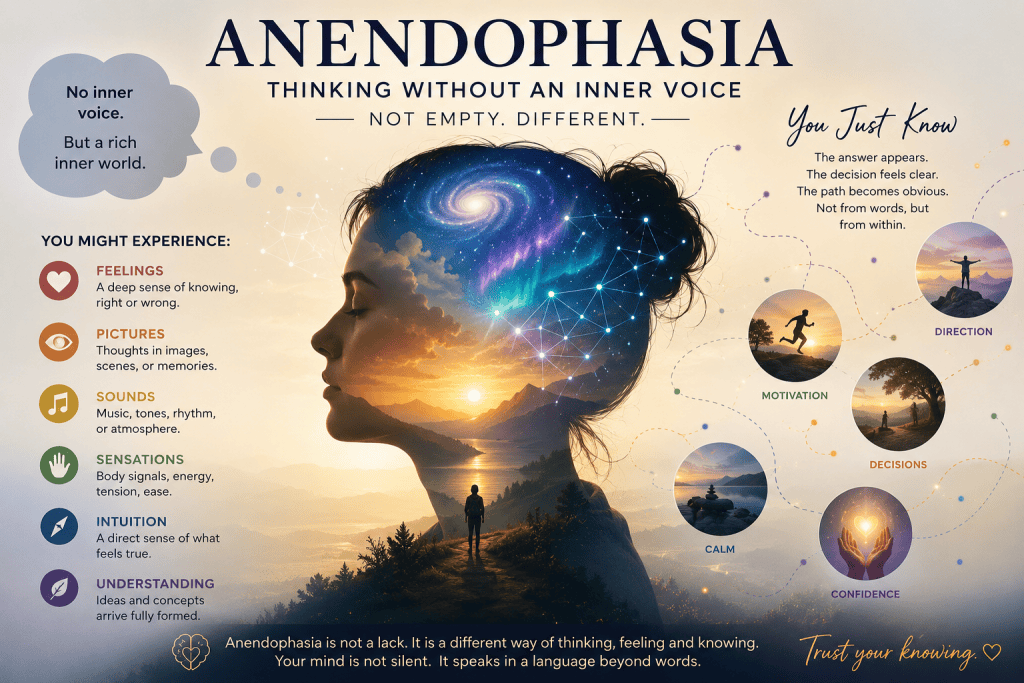
You May Already Know More Than You Realise
People without a strong inner voice may think through:
- feelings
- images
- patterns
- sensations
- emotional signals
- instinctive knowing
- body responses
- memories
- sounds
- movement
- atmosphere
- direct understanding
Instead of hearing a sentence in the mind, the answer may simply arrive.
You may not say to yourself, “I need to do this next.”
You may just know.
You may not mentally debate every option in words.
You may feel the pull towards one choice.
You may not describe an idea internally.
You may sense the shape of it before you can explain it.
This is not lesser thinking.
It is different thinking.
The Silent Mind Is Not an Empty Mind
One of the biggest misunderstandings around anendophasia is the idea that no inner voice means no inner life.
That is not true.
A person may have no internal speech and still have a rich inner world full of feelings, images, music, intuition, body sensations, emotional intelligence and deep understanding.
You may think in pictures.
You may think in physical sensations.
You may think through rhythm, movement or atmosphere.
You may feel motivation as energy in the body rather than words in the head.
You may experience decisions as a sense of yes, no, stop, go, wait, move, avoid, trust.
You may not talk yourself into action.
You may feel yourself move into action.
How Motivation Can Work Without Inner Speech
Many people are taught that motivation comes from self-talk.
“Tell yourself you can do it.”
“Repeat the affirmation.”
“Challenge the thought.”
“Change your inner dialogue.”
But what if you do not have much inner dialogue?
Then motivation may need to be accessed differently.
For someone with anendophasia, motivation may come from:
- a feeling of alignment
- a strong emotional reason
- a visual image of the outcome
- a memory of success
- a physical sense of readiness
- a gut feeling
- a rhythm, sound or song
- a sense of identity
- an inner knowing
- the feeling of movement beginning
You may not need to hear the words, “I can do this.”
You may need to feel the state of doing it.
Feelings, Pictures, Sounds and Sensations
If inner speech is quiet or absent, other internal channels may become more important.
Feelings
You may know something is right because it feels settled.
You may know something is wrong because your body tightens.
You may recognise confidence as warmth, openness, calmness, energy or steadiness.
Pictures
Some people without inner speech still have strong mental imagery.
You may see outcomes, places, faces, colours, memories or imagined scenes.
A picture may carry more meaning than a paragraph of words.
Sounds
Even without an inner speaking voice, you may still experience music, rhythm, tone, atmosphere or remembered sounds.
A song, beat or sound may shift your emotional state faster than verbal self-talk.
Sensations
You may think through the body.
A lightness.
A heaviness.
A pull forward.
A sense of pressure.
A release.
A calm certainty.
The body may become part of how your mind communicates.
You Just Know
Many people with little or no inner voice describe a form of direct knowing.
The answer appears.
The understanding arrives.
The decision becomes obvious.
That does not mean intuition is always correct. Nothing is always correct.
But it does mean your mind may already be processing information beneath the surface, without needing to convert everything into words first.
You may have been using this ability for years without realising it.
Therapy and Coaching for Anendophasia
Many traditional approaches rely heavily on inner dialogue.
But if you do not naturally think in words, then change work may need to be adapted.
Instead of focusing only on “changing your self-talk,” we can work with:
- emotional states
- identity
- body sensations
- subconscious patterns
- visual or symbolic thinking
- instinctive responses
- behaviour patterns
- confidence states
- performance states
- felt motivation
- future direction
The aim is not to force you to develop an inner voice.
The aim is to work with the way your mind already works.
Anendophasia and Aphantasia
Anendophasia is about inner speech.
Aphantasia is about visual imagery.
Some people may experience one, both, or neither.
For example, someone may have no inner voice but strong pictures.
Someone else may have no mental pictures but strong inner speech.
Another person may think mainly through feelings, sensations, concepts or direct understanding.
There is no single correct way to think.
You Are Not Broken
If you have spent years assuming everyone else has a mental narrator and you do not, it can feel strange to discover there is a name for it.
But anendophasia is not a failure.
It is not stupidity.
It is not emptiness.
It is not a lack of depth.
It may simply mean your mind does not rely on spoken language as its main internal operating system.
You may still be thoughtful, creative, emotionally intelligent, intuitive, capable and deeply aware.
You may just think differently.
Anendophasia Support
If you recognise yourself in this and want to understand how your mind works, I can help you explore your own internal system.
Together, we can look at how you experience:
- motivation
- confidence
- decision-making
- emotional blocks
- intuition
- performance
- self-trust
- subconscious patterns
- identity
- change
You do not need to force your mind to work like somebody else’s.
You can learn to use the way your mind already works — more clearly, more confidently and more deliberately.
Frequently Asked Questions
What is anendophasia?
Anendophasia is the experience of having little or no inner speech. This means a person may not hear words, sentences or a speaking voice inside their mind when thinking.
Does anendophasia mean I do not think?
No. It means your thinking may not happen mainly through internal words. You may think through feelings, images, sensations, concepts, intuition or direct knowing.
Is anendophasia a disorder?
No. It is not currently considered a disorder. It is better understood as a difference in internal experience.
Can you have anendophasia and still be intelligent?
Yes. Inner speech is only one way the mind can process information. Many people think effectively without relying on a verbal inner monologue.
Can therapy work without inner speech?
Yes, but the approach may need to be adapted. Instead of relying only on self-talk, therapy can work with feelings, body responses, imagery, behaviour, identity and subconscious patterns.
Is anendophasia the same as aphantasia?
No. Anendophasia relates to inner speech. Aphantasia relates to mental imagery. They are different experiences, although some people may have both.
MAIL@THEEXCELPRACTICE.COM OR CALL 07807 540142